How we're using AI to prototype, build, and create.
Animals are pretty easy when it comes to AI. We've accepted talking animals for decades. But fake humans for brands? That gets more complicated, both practically and philosophically.
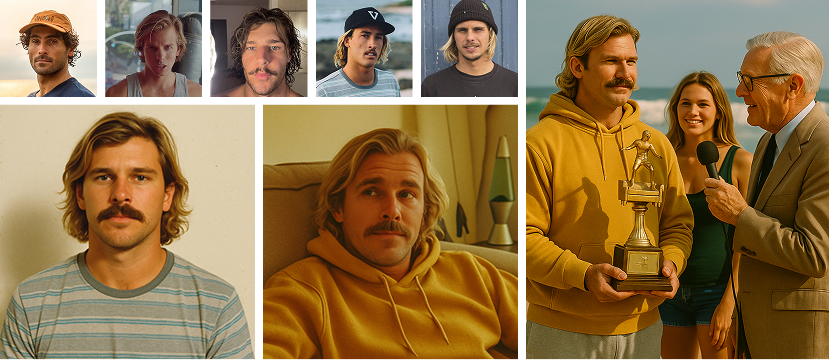
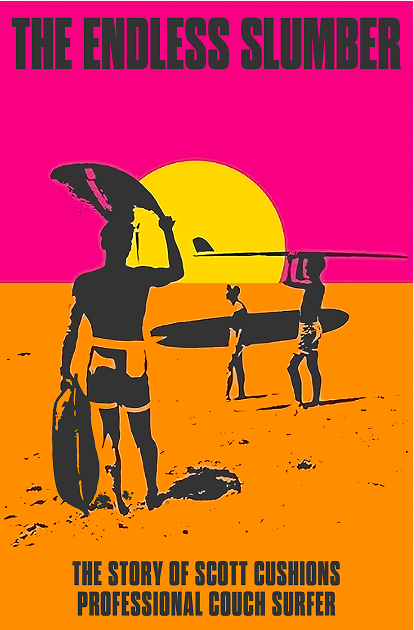
The short answer: We think it can work when the audience knows it's fake, when everyone's in on the joke. The longer, practical answer is what we've been exploring as a creative department with AI tools. We recently developed an AI-generated character named Scott Cushions, a "World Champion Professional Couch Surfer," for an outdoor hospitality brand. The idea itself is intentionally ridiculous but rooted in something real: the universal adventure-town ritual of crashing on a friend's couch when you roll into town to ski, surf, or bike. In this case, our client had a great alternative to couch surfing: a modern, affordable hotel room with adventure-community vibes.
But the real value for us was the process: using AI to prototype, build, and pressure-test a creative concept quickly. This idea hasn't been produced yet, but building it gave us a hands-on look at how AI fits into a modern agency workflow from concepting to character design to content prototyping.
Building a Digital Character
Creating an AI character is more than a face, it's building a digital actor. We treated Scott like we would any casted role: defining his voice, look, mannerisms, and presence. The difference was that instead of talent searching, we iterated through AI tools to shape those elements. Providing good inputs also helps, “this is a mockumentary-style series, Scott talks about couches the same way surfers talk about waves. He analyzes cushion density, spring rebound, and “ride lines” across sofas. Restoration Hardware? West Elm? Crate & Get Barreled? He's ridden them all.”
This process revealed something important: AI works best when it's guided with clear creative intent. The tools are powerful, but without a strong point of view, outputs quickly become generic.
We also learned that consistency is key. Getting a character to feel cohesive across different scenes, angles, and formats takes deliberate iteration and testing, something AI enables but doesn't solve automatically. But the tools are getting better every day.
Ideas before AI in the Creative Process
Every project still starts the same way, with a human imagined idea. But what's changed is how quickly we can pressure test that idea once it exists. Instead of moving straight into traditional production planning, we used AI to rapidly sketch, test, and evolve the concept. That included:
- Generating quick character explorations
- Testing different visual directions and personalities
- Prototyping environments and scenes
- Producing short video clip outputs
What used to take weeks of coordination and production setup can now happen in hours. That speed doesn't replace creative thinking, but it allows us to explore more directions, kill weaker ideas faster and refine stronger ones earlier.
Prototyping Content
One of the biggest shifts is that we 're no longer just presenting ideas, we 're prototyping executions. We explored what a short-form content series could actually look and feel like before production. We tested tone, pacing, and visual style in a way that 's much closer to a finished product than a traditional pitch.
This has two major benefits:
- Clients can better understand and react to the idea
- Creative teams can identify what 's working (and what 's not) much earlier
AI effectively compresses the gap between concept and content. We 're building and testing stories without traditional production overhead. It doesn 't mean always replacing live production. It means expanding the toolkit.
What 's Next
At Catalysis, we 're continuing to experiment with AI across concepting, visual design, motion, and storytelling. Every major creative tool shift (Photoshop, digital video, drones, smartphones) has expanded what 's possible. AI is doing the same, but with more efficiency than ever. Which, for a creative department, more time going towards original creative thinking is the most valuable part. Oh, and yes, we are also experimenting with talking animals for a beer brand we work with. Why? Because we can now and it 's gotten so much easier to play around and see.

Key tips and takeaways
Rapid prototyping
We're using AI to quickly build website and landing page prototypes, bringing ideas to life in a way clients can see, click, and react to, instead of imagining from static comps.Scalable visual systems
AI is helping us develop easy-to-use image treatments, filters, and visual styles that clients can apply themselves—creating more consistency without constant design lift.Training AI to match brand voice
We're building AI writers tailored for individual clients. Outputs feel on-brand, are product-accurate, less generic and used everything from social to scripts to web copy.Faster iteration across outputs
Whether it's design, copy, or motion, we can generate and test multiple variations quickly—dialing in tone, pacing, and visuals.Expanding what small teams can do
AI is allowing us to produce more types of content, more often, without scaling up time or budget, making experimentation a more regular part of the workflow.